Anglo-Saxon cemetery with 60 graves found during Lincolnshire road widening
Archaeologists say the sixth-century burials, including a woman interred with a glass beaker and a sword-bearing teenager, could rewrite what is known about early settlement in the Wolds
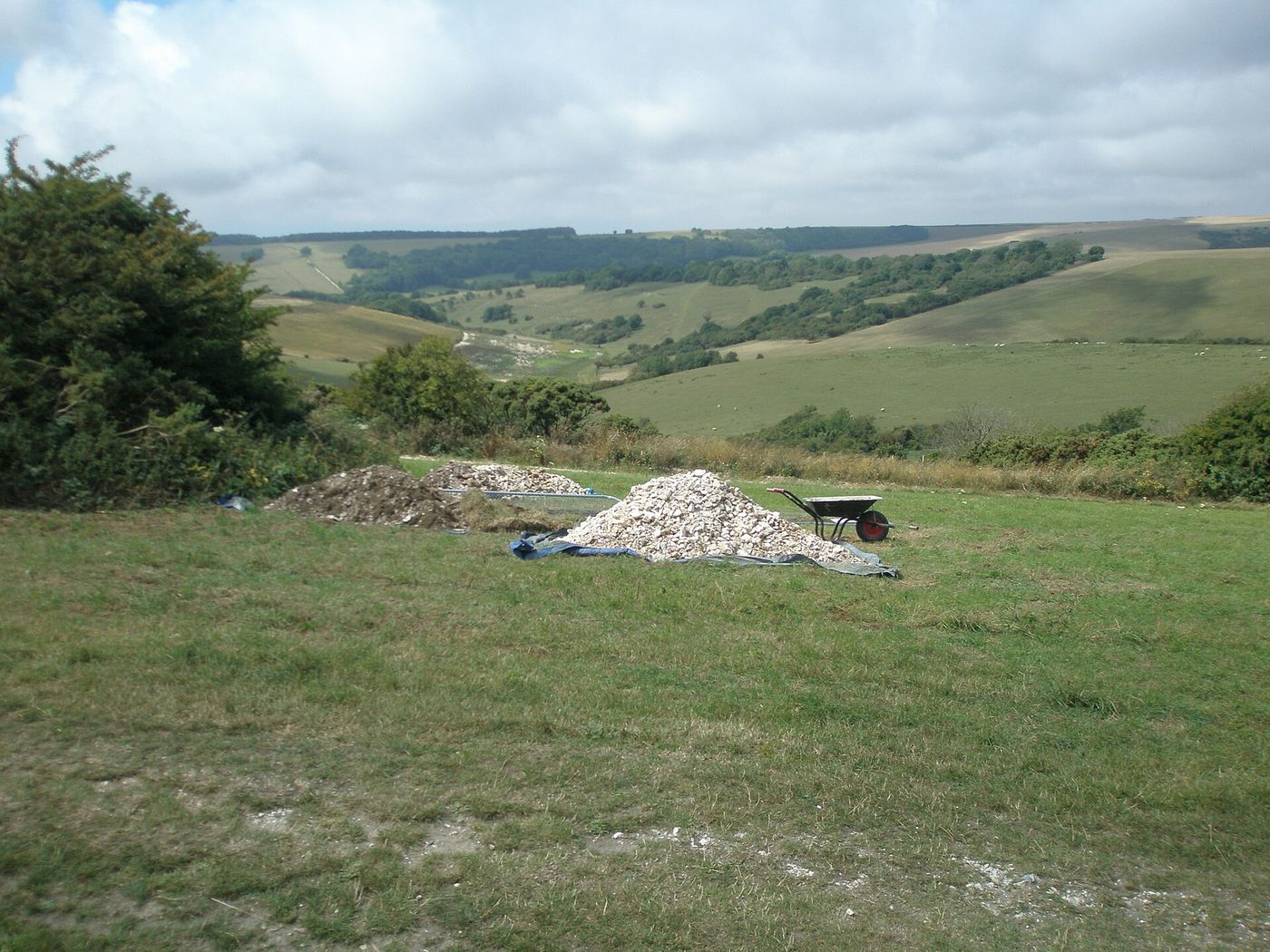
A sixth-century Anglo-Saxon cemetery containing at least 60 graves has been uncovered on a chalk ridge in the Lincolnshire Wolds during preparatory work for a road scheme, in what archaeologists are describing as the most important early medieval discovery in the county for a generation.
The site, near Horncastle, was identified in July when a routine geophysical survey ahead of a bypass widening showed a dense cluster of anomalies in a field that had been under plough for centuries. Excavation by Trent Archaeology, a commercial unit, has since revealed inhumation burials laid out in rows, several containing grave goods of a quality the team did not expect. Details were released on Friday after the finds were secured.
“We went in expecting a few dozen Roman field ditches,” said Dr Priya Hallam, the project director. “What we have is a community. These are people who lived within a few miles of this spot, buried over perhaps three generations, with their belongings. It is, frankly, the site most of us go an entire career without seeing.”
Among the most striking burials is that of a woman aged between 35 and 45, interred with a near-intact claw beaker of pale green glass, a type usually associated with high-status graves in Kent and the Rhineland and only rarely found this far north. Nearby lies a male aged about 16 buried with a sword, a spear and a shield boss, an unusually complete weapon set for someone so young. Several graves contained amber beads, copper-alloy brooches and the remains of textiles preserved by contact with the metalwork.
The ridge sits above a tributary of the River Bain, roughly midway between two known Anglo-Saxon settlement sites, and Hallam believes the cemetery may help resolve a long-running debate about how quickly Germanic cultural practices spread into the Lincolnshire uplands after the end of Roman rule. Isotope analysis of the skeletons, which can indicate where individuals grew up, is to begin at a university laboratory next month. “The question everyone asks is: were these people migrants or locals who adopted new ways?” she said. “For the first time in this part of the county we might actually be able to answer it.”
The county council, which is funding the bypass, confirmed that the road alignment would be adjusted to avoid the core of the cemetery, at a cost it put at “under £2m”. The highways portfolio holder, Councillor David Askew, said the authority had “no hesitation” about the change. “You can build a road in a lot of places,” he said. “You can only find this once.”
Excavation of the remaining graves is expected to continue until the end of November. The finds will be conserved and studied before going on display at the county’s museum in Lincoln, provisionally in 2028.
Sign up to First Edition
Our morning email breaks down the key stories of the day, telling you what's happening and why it matters.
Privacy notice: newsletters may contain info about charities, online ads and content funded by outside parties.