Salt and Iron review – a Cheshire salt mine becomes a cathedral of grief
★★★★☆ Kezia Morrow’s new play for the Royal Exchange puts three generations of a mining family in a single underground chamber and refuses to let anyone leave
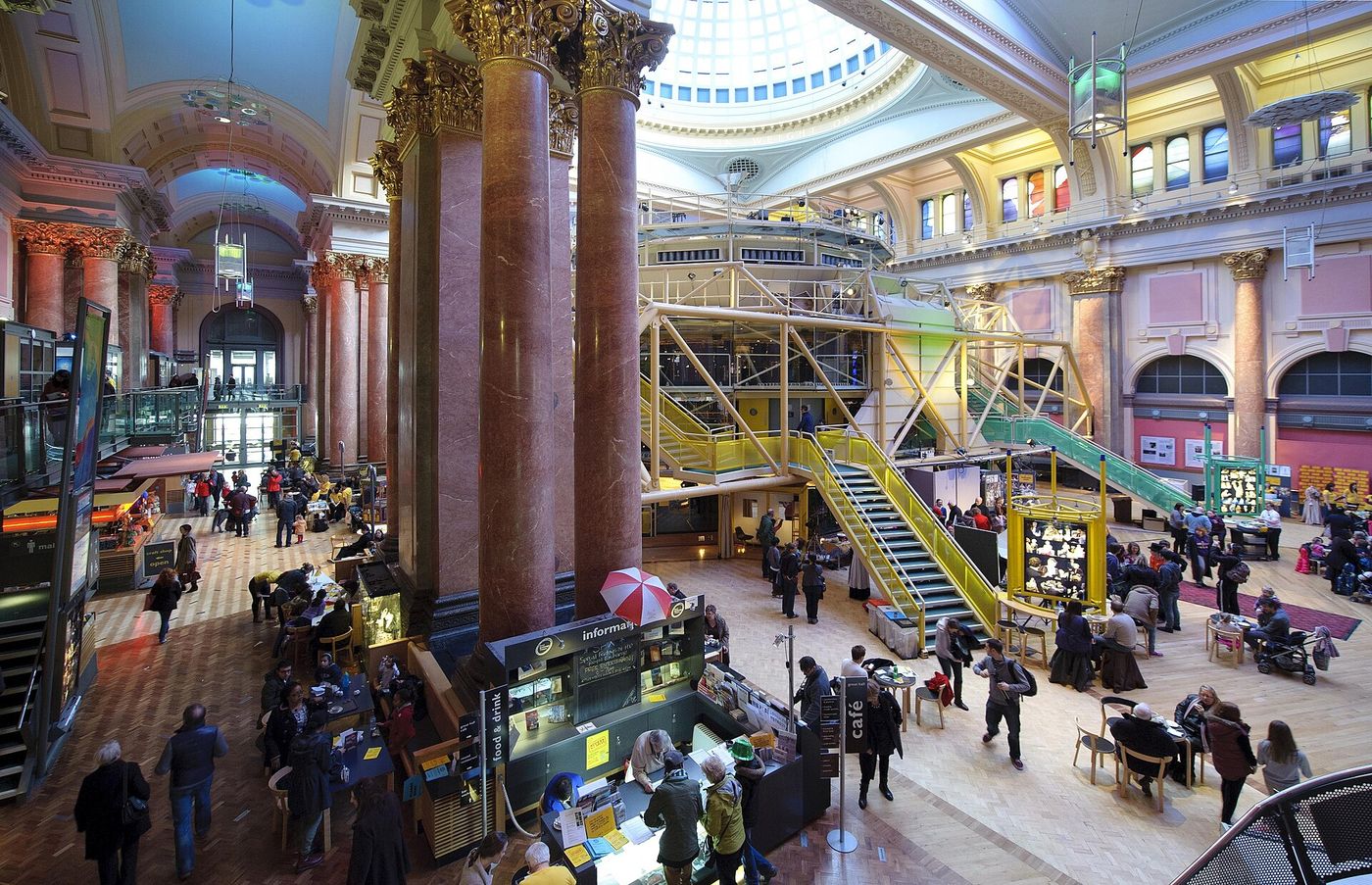
The Royal Exchange’s glass-and-steel module, hung inside a Victorian trading hall, is one of the strangest theatres in Britain, and Kezia Morrow’s new play uses it as though it had been built for the purpose: for two hours it is a chamber 150 metres underground in a Cheshire salt mine, and the audience, ranged in the round, are the walls.
Salt and Iron takes place on the night in 2026 that a fictional mine near Northwich, the last working rock-salt mine in England, is to be closed. Three generations of the Askew family, grandfather Len, who dug it, daughter Carol, who runs the weighbridge, and grandson Tyler, who has a job lined up in a warehouse in Warrington, are the last shift. They are supposed to be collecting tools. They end up, over two hours without an interval, saying everything that 40 years of working alongside each other had made unsayable.
Morrow, whose previous play, Weighbridge, won the Bruntwood prize in 2023, writes in a dialect so precise it should be taught, and she has an ear for the way working families argue, in parallel monologues rather than exchanges, that reminded me of the best of the kitchen-sink dramatists without ever sounding like a pastiche. She is funny, too. A 10-minute argument about whether a particular foreman in 1987 was called Graham or Grahame is the comic high point of the year, and it turns, in a single line, into something that makes the room go still.
Pete Ashworth is magnificent as Len, a man of 79 who has not been down the mine for 20 years and finds, in the first scene, that he still knows which way is north. Jo Millington’s Carol is the play’s engine, a woman who has held the place together and is beginning to understand that she will not be thanked for it. Only Tyler, played by Callum Rees with real charm, is slightly underwritten, a device for the older characters to explain themselves to rather than a person with a stake of his own.
Sarah Frankcom’s production is spare in the right way: a floor of rock salt, real, that crunches under the actors’ boots, a single caged lamp, and a sound design by Mo Tilley that uses the creak of a working mine so sparingly that when the roof speaks, late on, half the audience looked up. The decision to play without an interval is correct; the play is a pressure vessel and letting the air out would have ruined it.
There is an ending that does not quite land, a coup de théâtre involving the lamp that is one gesture too many, but the final image, of Len alone on the salt, is beautifully done and the right note to leave on. Morrow is now, on the strength of two plays, one of the most important dramatists in the north. Manchester is lucky to have her.
Salt and Iron is at the Royal Exchange, Manchester, until 21 November.
Sign up to First Edition
Our morning email breaks down the key stories of the day, telling you what's happening and why it matters.
Privacy notice: newsletters may contain info about charities, online ads and content funded by outside parties.